Taking over a business? Opportunities, challenges and first considerations
Reading Time: 6 Minutes

Taking over a business is a major decision. Unlike starting from scratch, you step into something that already exists. That brings opportunities. But also challenges. This article gives you factual orientation, with first considerations on what to look out for when planning a business takeover.
The opportunities of a takeover
Existing customer base
The business already has customers. They know the products, the services, the quality. You do not need to invest years building trust. Revenue flows from day one.
An established team
Employees are there. They know the processes, the customers, the specifics of the business. You benefit from their knowledge and experience.
Working processes
Purchasing, production, sales. The structures are in place. You do not have to build everything from scratch. You can focus on where optimisation is needed.
Figures as a foundation
Balance sheets from recent years show how the business operates. You can see revenue, costs, profits. You can realistically calculate whether the takeover is viable.
Transition phase with the predecessor
Often the previous owner stays on for a period. They onboard you, introduce key contacts and pass on their knowledge. This handover is crucial for the success of the takeover.
The challenges of a takeover
Purchase price and financing
The takeover costs money. Often more than you have in the bank. You need financing. Banks check carefully: is the business viable? Can you service the loan from the earnings? Equity matters. The more, the better.
Hidden risks
Figures on paper do not tell the whole story. Perhaps the revenue depends on one large customer who could leave at any time. Perhaps the machinery is older than expected. Perhaps there are legal liabilities from the past. A thorough examination is essential.
Changing existing structures
You take over established processes. Some work well. Others need to be adapted. Change takes time. And it requires the willingness of the team to come along.
Bringing the team on board
The team may have worked together for years. The seller was the boss. Now you arrive. That is an adjustment. For everyone. You need to build trust. You need to show that you run the business well. And you need to be open to the knowledge that already exists.
The seller's emotional attachment
For the seller, the business is often a life's work. They have invested decades. Letting go is hard. Sometimes there are expectations that are difficult to meet. An honest conversation at the start helps.
First steps in planning a business purchase
Clarity about your goals
What do you want to achieve? Do you want to run a business you can develop further? Are you looking for stability and a functioning operation? Do you want to work in a particular industry? The clearer your goals, the easier the search.Checking your financial options
How much equity do you have? How much credit can you take on? Banks typically require 20 to 30 per cent equity. Be realistic. The purchase price is not everything. You also need reserves for ongoing costs, investments and unexpected expenses.Narrowing down industries and regions
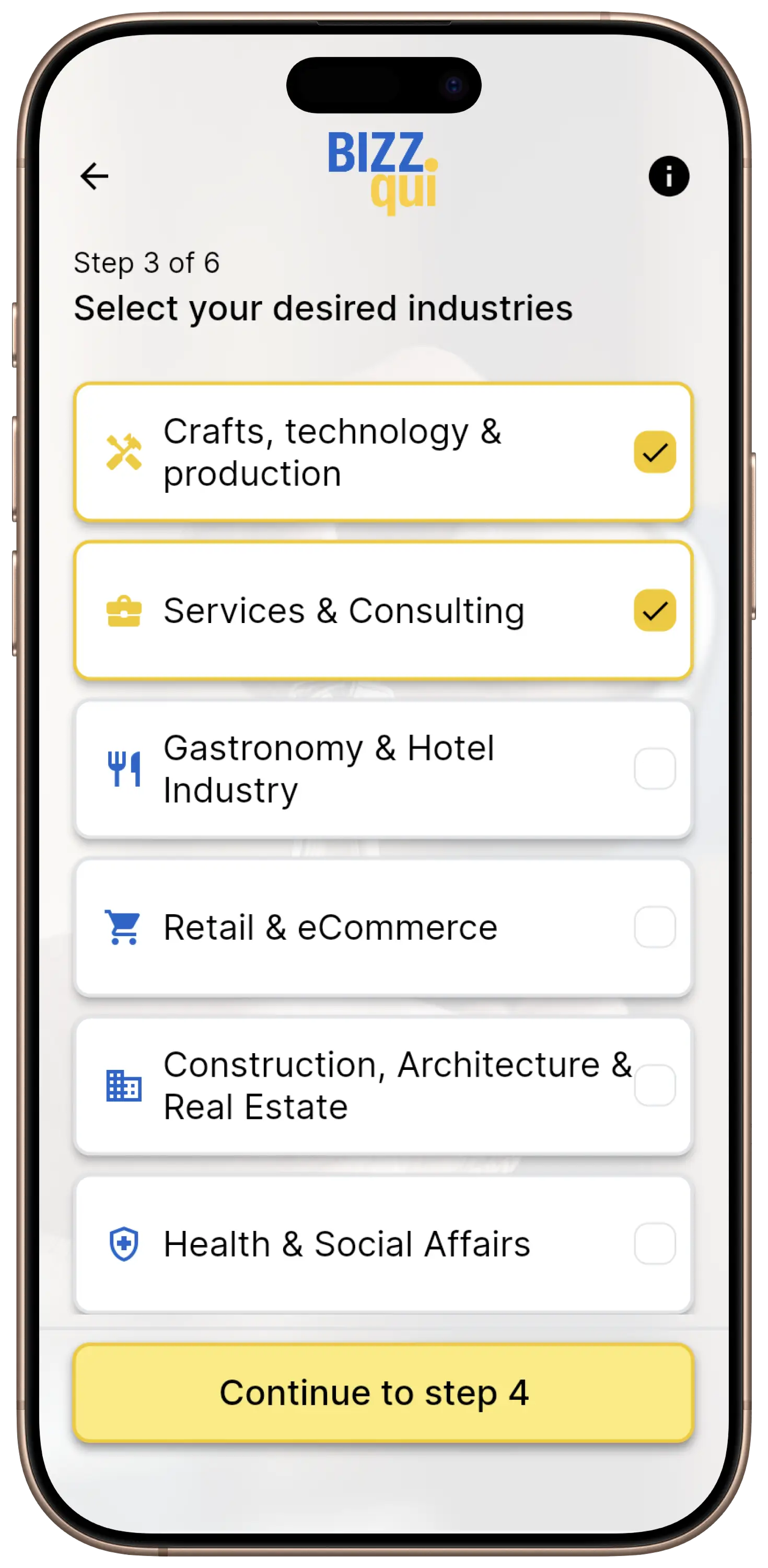
Where do you want to work? In your region? Or are you willing to relocate? Which industries come into question? The clearer your criteria, the more targeted the search.Building first contacts
Where do you find businesses to take over? Through platforms, through networks, through accountants, through chambers of commerce. Or through apps like BIZZqui, which connect buyers and sellers directly.Going into the conversation openly
The first contact matters. Check whether the chemistry is right. Whether the expectations broadly align. Whether you can imagine walking part of the road together. Only then is the next step worthwhile.
What you should check before a takeover
Analysing the figures thoroughly
Have the balance sheets from the last three to five years shown to you. How are revenue and profit developing? Are there any anomalies? Where do the earnings come from? Are there dependencies on individual customers?
Understanding the customer structure
Who are the largest customers? How stable are the relationships? Are there contracts? What happens if a major customer leaves?
Getting to know the employees
Who works in the business? For how long? Are there key people without whom the operation would not function? What is the mood in the team?
Estimating investment needs
What machinery, vehicles and IT systems are in place? How old are they? What needs to be replaced in the coming years? That costs money. Plan for it.
Clarifying legal questions
Are there open contracts? Are there legal risks? Are all permits in place? Get advice from a lawyer.
Planning financing realistically
Banks finance business acquisitions. But they want security. They check:
Is the business profitable?
Can you service the loan from the earnings?
Do you have enough equity?
Do you have experience in the industry?
Solid financing takes time. Allow several months. Talk to banks early. Prepare all documents. Show that you understand the business and can run it.
Sometimes there is also a seller loan. The seller finances part of the purchase price themselves. That shows trust. And it makes bank financing easier.
Staying realistic
A business takeover is not a given. Even if the business is doing well, the takeover means work. You need to find your footing. You need to win over the team. You need to show customers that things continue.
But: you do not have to do everything alone. Accountants, advisors and lawyers help with legal and tax questions. Banks help with financing. The seller helps during the transition.
And you? You bring motivation, a sense of responsibility and the will to carry the business forward. That is the most important foundation.
The first step: making contact
The decision to take over a business begins with a conversation. With a first contact between buyer and seller. There you check whether you fit together. Whether the expectations broadly align. Whether it makes sense to keep talking.
BIZZqui makes exactly this possible. An app that connects buyers and sellers in a targeted way. Anonymously, until both are ready. With a chat room to say quickly: there is interest. Let us talk.
Only then do the next steps follow. The valuation. The advisors. The contracts.
But at the beginning, there is the encounter. Between people.