Preparing for business succession: why the right time comes sooner than many think
Reading Time: 5 Minutes

For many business owners, the thought of handing over their company is not an easy one. Over the years, often over decades, something has grown that goes far beyond an economic unit. It is a life's work. It takes a great deal of resolve to prepare early, to face the idea of stepping back and to make room for a successor.
We have had many conversations. With business owners who are thinking about succession. With advisors who support the process. We keep hearing the same thing: many do not think about it for too long, the topic gets postponed. Doubt, uncertainty and emotional attachment lead to decisions being put off. And sometimes businesses lose their appeal as a result. Or successions take place under time pressure.
Planned or unplanned
It makes a significant difference whether a succession is planned or unplanned.
A planned succession comes from a conscious decision. There is time to explore alternatives, gather information and prepare the transition step by step.
Unplanned successions often arise from external events. Illness. Family conflicts. A sudden decision to stop. In such situations, action must be taken quickly to secure the future of the business. It is precisely in these moments that it becomes clear how important an early engagement with the topic would have been.
Succession is a process
Succession unfolds in phases. It begins with the inner decision to hand over. This phase is often shaped by emotions and accompanied by questions: when is the right time? Who could even be considered? What will happen to the business and the employees?
This is followed by the preparation phase. Now it is about figures, structures, valuations and legal frameworks. The question of how and where to find a suitable successor also comes into focus.
Only after that do concrete discussions about prices, contracts, financing and the details of the handover begin. The implementation concludes the process and includes, among other things, onboarding the successor and handing over customer and supplier relationships.
Why early contact matters
What many models overlook is the moment between the inner decision and the formal preparation. It is often right here that the fate of a succession is decided.
Before figures are reviewed, valuations prepared and contracts discussed, there is a fundamental question: do the person and the business actually fit together? Can you imagine walking part of the road together?
An early personal exchange does not replace a valuation or a contract. But it creates orientation. For you as a business owner who wants to feel to whom you are entrusting your life's work. And for the potential successor who wants to understand what lies behind the figures.
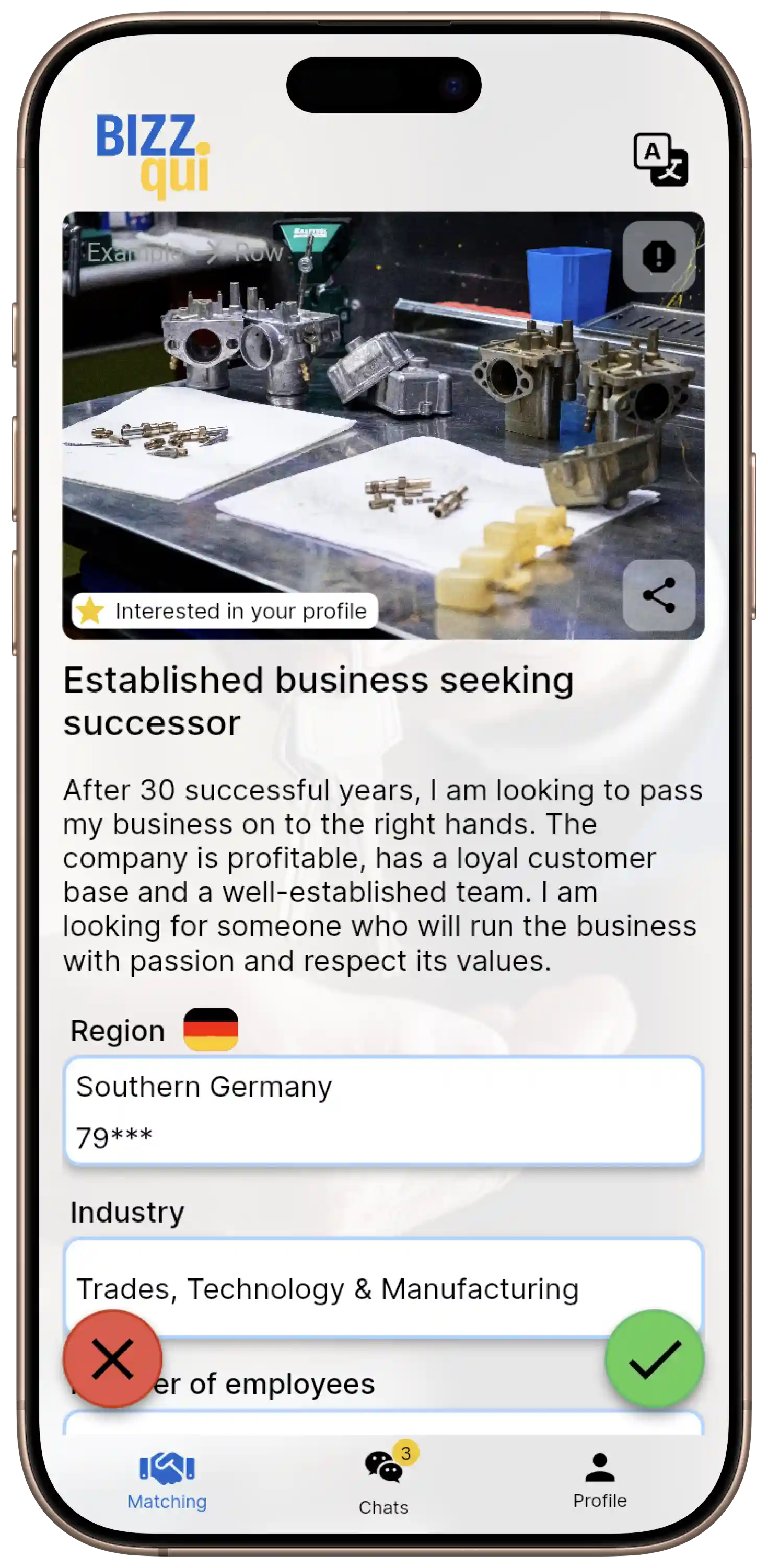
This is exactly where BIZZqui comes in. We make an early, protected first contact possible between business owners and potential successors. Before the formal process begins. And before time becomes pressure.
Starting early means gaining room to act
The right time comes sooner than many think. Preparing early means gaining time and calm. Time for conversations. Time to take stock. Time for decisions without pressure.
Starting early means: searching for a successor in a focused way, before time becomes pressure. You decide when you sell. But the search should begin early.
This gives you clarity. And it gives you the chance to find the right person, rather than having to decide under time pressure. This gives you clarity. And it gives you the chance to shape the process, rather than being driven by it.
The first step
Business succession is not a single act, but a strategic process. And this process does not begin with contracts, but with an encounter.
With a match on BIZZqui, a chat room opens. To say quickly: there is interest. Let us talk. When suits you?
If both say after the conversation "yes, this could work", the next steps follow. The valuation. The advisors. The contracts.
But at the beginning, there is the encounter. Between people.